Progress Predicts Policy
arXiv preprint
A scalar field that generates robot commands through a learned world model. Its gradients produce continuous motion, finite differences control the gripper, and field values estimate task progress.
Email: zlicheng [at] u [dot] nus [dot] edu
I’m a Ph.D. student in Computer Science at the National University of Singapore, advised by Prof. Gim Hee Lee. My research focuses on robotics and embodied AI, including manipulation and robot perception, as well as 3D vision and physical scene understanding.
Previously, I was a research assistant at Shanghai Qi Zhi Institute, advised by Prof. Li Yi, and a visiting research intern at the Stanford Vision and Learning Lab, advised by Prof. Jiajun Wu and Prof. Yunzhu Li.
I received my B.Eng. in Mechanical Engineering from Shanghai Jiao Tong University, where I worked with Prof. Cewu Lu and Prof. Lixin Yang at MVIG. My undergraduate thesis was supervised by Prof. Peter Bradley Shull.
Feel free to get in touch.
* Equal contribution
arXiv preprint
A scalar field that generates robot commands through a learned world model. Its gradients produce continuous motion, finite differences control the gripper, and field values estimate task progress.
arXiv preprint
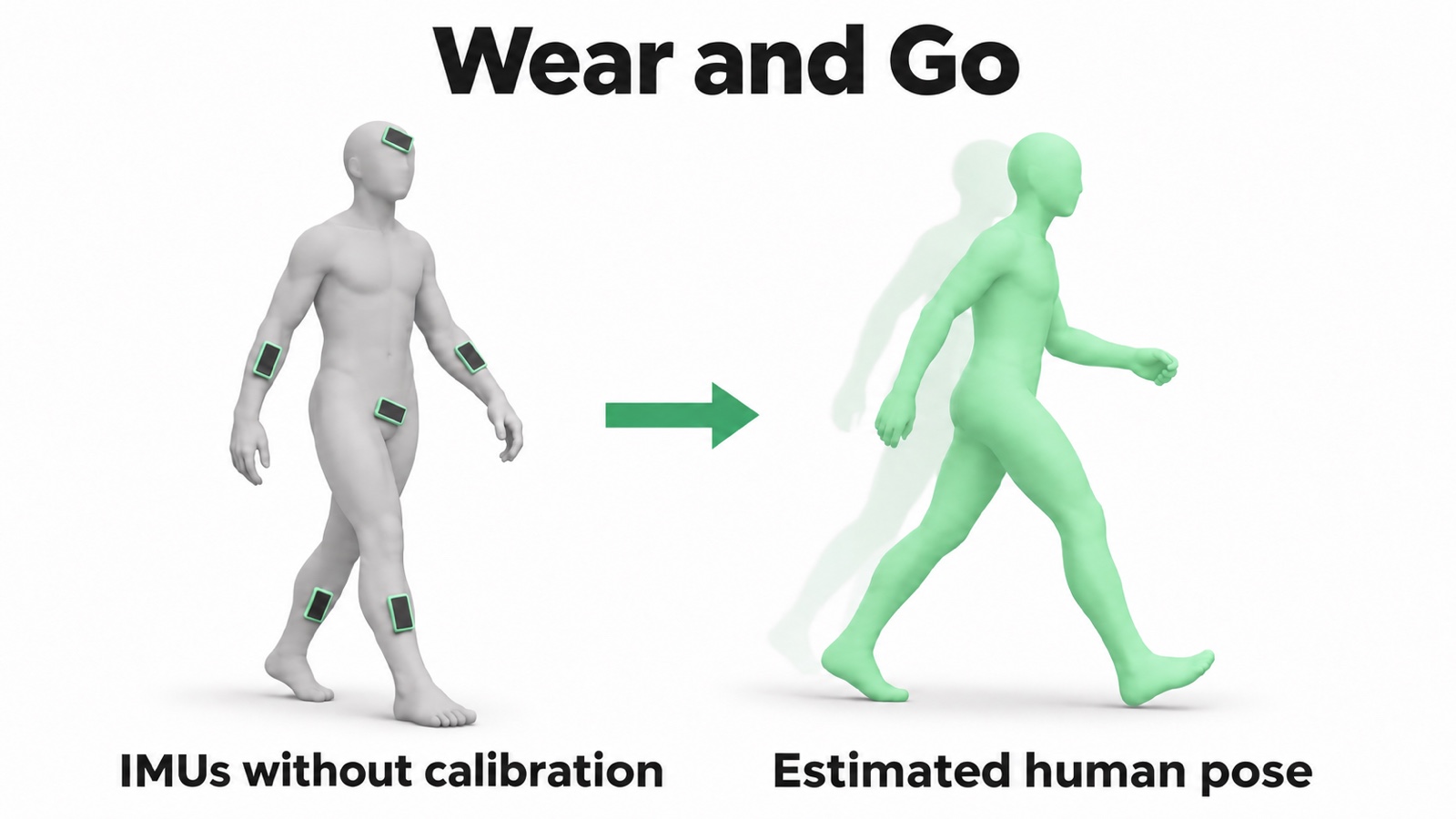
A calibration-free inertial motion capture framework that recovers sensor identities and mounting orientations from ordinary movement.
ECCV 2026
A grasp-oriented manipulation framework that learns a scalar measure of grasp feasibility, guiding robots to reconfigure objects and autonomously transition to grasping without predefined target poses.
ICRA 2026 · Best paper finalist
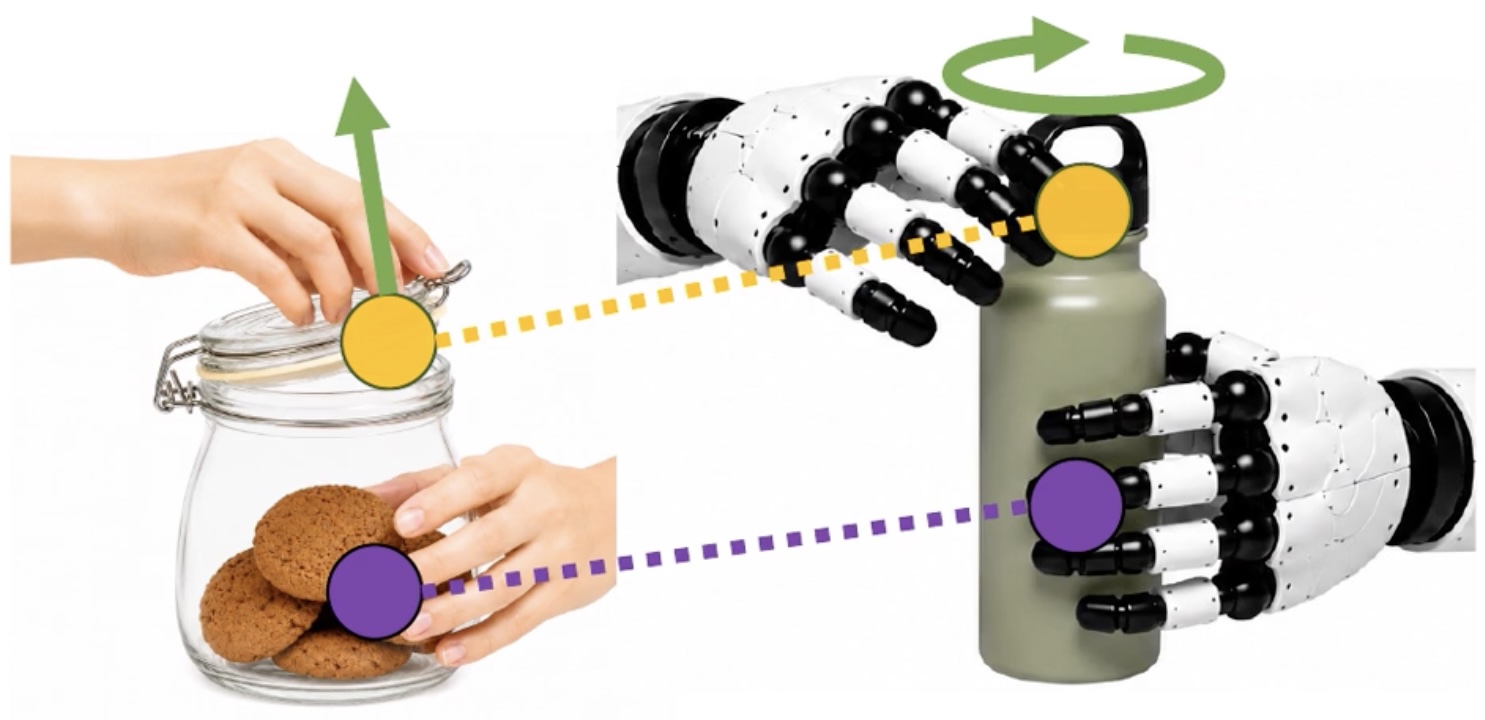
A few-shot bimanual manipulation framework that leverages semantic correspondences from vision foundation models to transfer manipulation skills across novel object categories with limited training data.
arXiv preprint
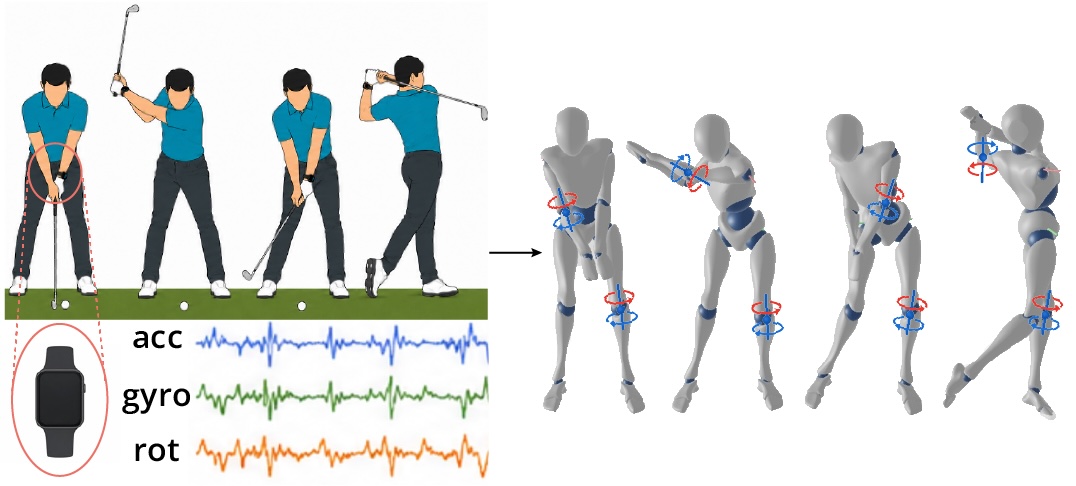
This work presents the first method for reconstructing full-body golf swing kinematics from a single wrist-worn IMU, enabling practical swing analysis during real-world play.
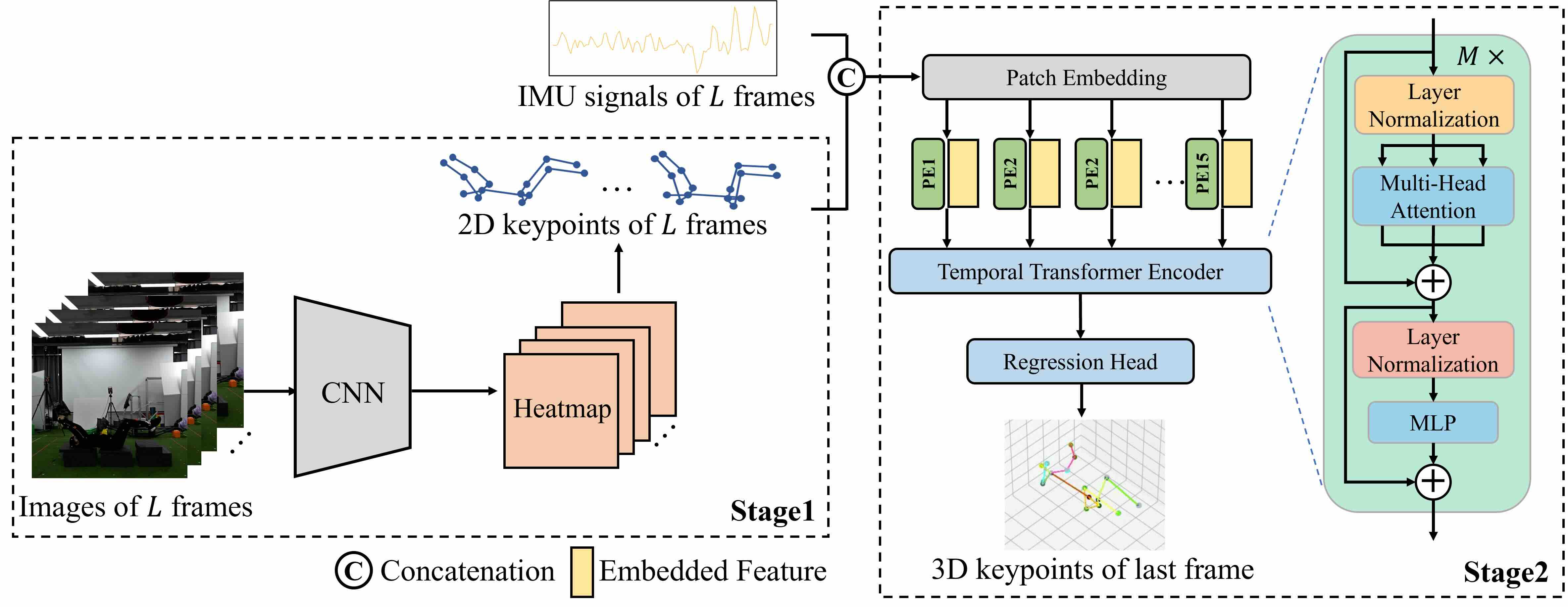
BSN 2025 · Oral presentation
This work proposes a temporal transformer-based method that fuses images and IMU data to improve 3D human pose estimation for specialized rehabilitation exercises.
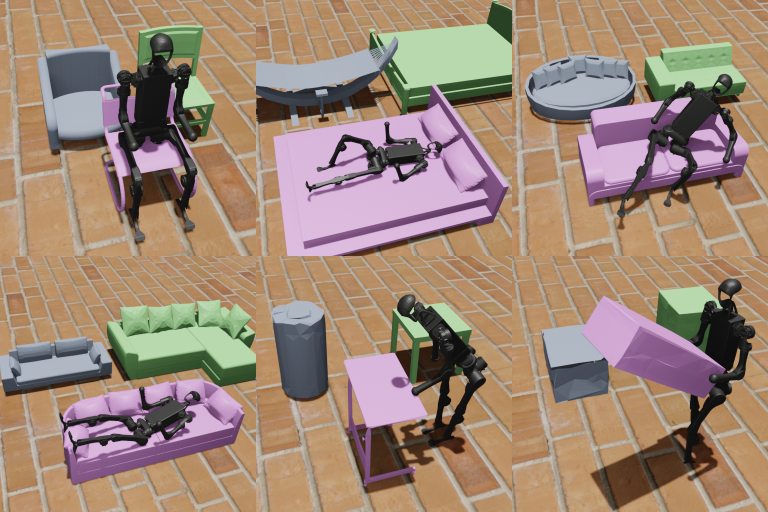
CVPR Workshop on Humanoid Agents 2025 · Spotlight
A benchmark for generalizable humanoid scene interaction learning from human motion, spanning tasks, object shapes, synthetic and real-world motion references, with modular evaluation of skill-learning pipelines.
ECCV 2024
A physically grounded 3D Gaussian representation that jointly reconstructs the appearance, geometry, and spring-mass dynamics of elastic objects from videos, enabling simulation under new initial conditions.
3DV 2024
A neural surface reconstruction approach that separates view-independent object color from view-dependent relighting, producing meshes with consistent vertex colors while preserving high-quality image rendering.
ICCV 2023
A category-level approach to reconstructing hand-held objects by deforming shared shape priors, accompanied by a diverse dataset of object instances, appearances, and hand interactions.
MLISE 2022
We simulated two centralized methods and two decentralized methods for multi-robot safe navigation in their respective environments.

Ph.D. in Computer ScienceSingapore
Computer Vision and Robotic Perception (CVRP) Lab
Advisor: Gim Hee Lee

Research AssistantShanghai, China
THU 3DVICI Lab
Advisor: Li Yi

Undergraduate Visiting Research InternCalifornia, USA
Stanford Vision and Learning Lab (SVL)
Advisors: Jiajun Wu and Yunzhu Li

B.Eng. in Mechanical EngineeringShanghai, China
Research Assistant, MVIG · Jan 2022 – Jun 2024
Advisors: Cewu Lu and Lixin Yang
Reviewer for ICCV, CVPR, ECCV, NeurIPS, AAAI, RA-L, and TVCG.
Outside research, I enjoy traveling, photography, skiing, diving, and mountain climbing.
I’m also interested in the intersection of AI and Web3. I’m keen to explore entrepreneurship.