
Publications
Progress Predicts PolicyLicheng Zhong, Gim Hee LeearXiv preprint, 2026 Project Page / arXiv / Code Progress Predicts Policy (PPP) represents robot tasks as language-conditioned scalar fields that directly induce actions through their local geometry. Composed with a learned world model, the field generates continuous motions from gradients and discrete gripper decisions from finite differences, while also providing progress estimates for execution monitoring. |
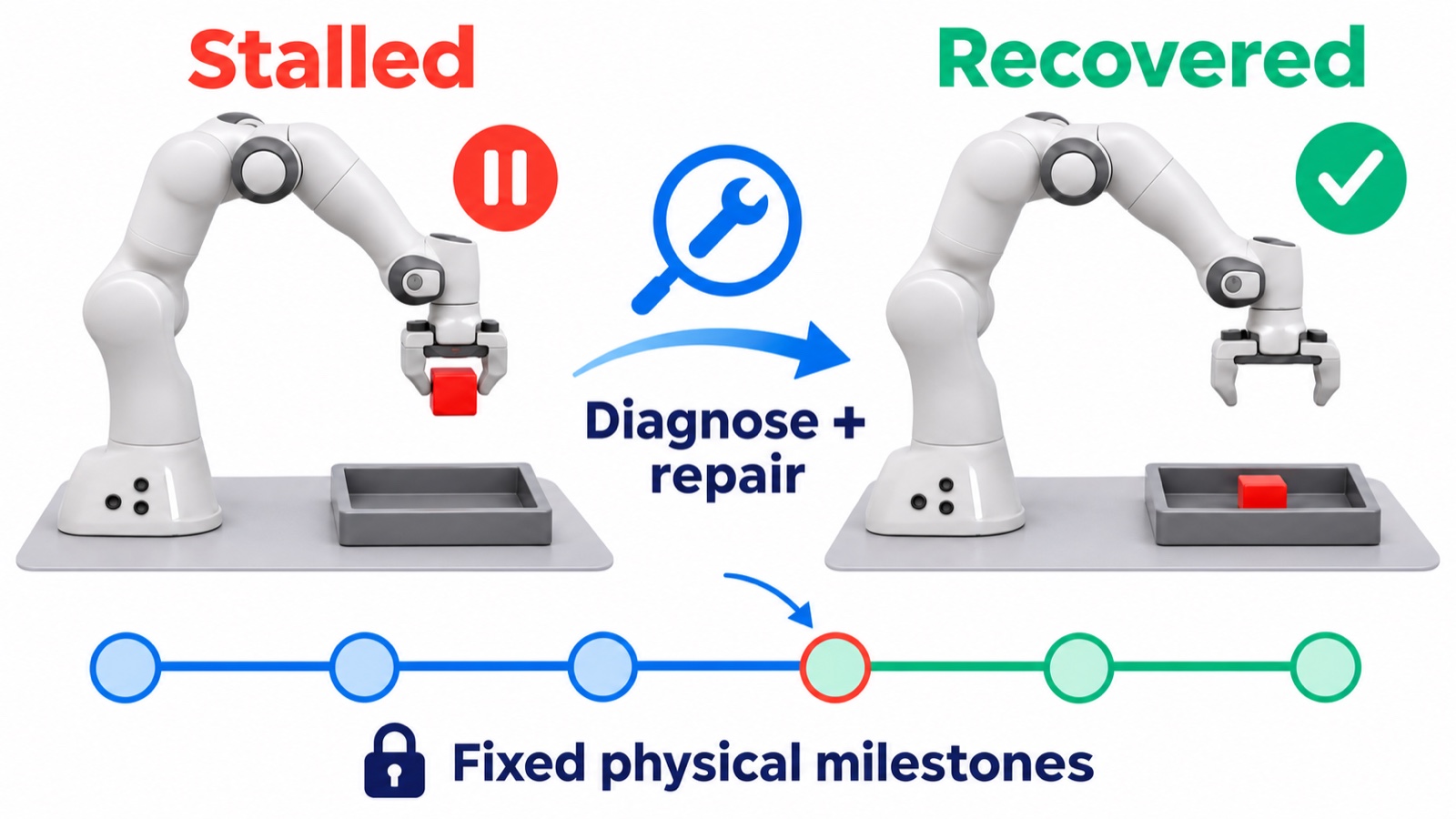 | Diagnosis-Guided Recovery from Curriculum Stalls in Agentic Robot Reinforcement LearningHui Yang, Wei Sun, Licheng Zhong, Gim Hee LeearXiv preprint, 2026 arXiv CADRE is an agentic framework for diagnosing and recovering from curriculum stalls in robot reinforcement learning. It uses fixed physical milestones to identify blocked transitions and guide targeted reward repair, verifying recovery without changing the behavioral goals. By reusing acquired skills, CADRE improves manipulation task completion while reducing training interactions.. |
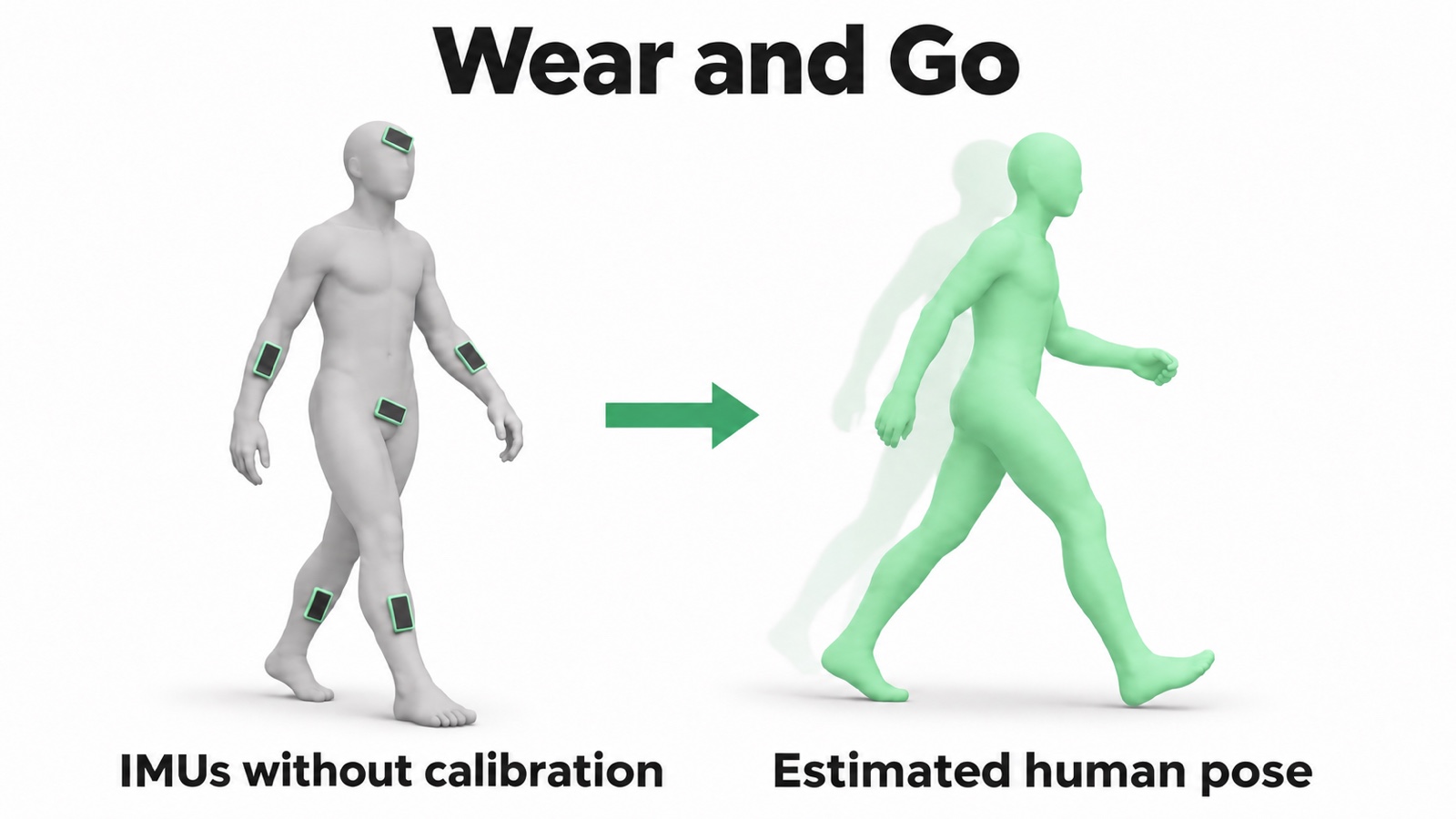 | Wear and Go: Calibration Free Sparse Inertial Motion Capture via Online Sensor Setup EstimationYuanshuo Tan, Licheng ZhongarXiv preprint, 2026 Project Page / arXiv Wear and Go enables full-body motion capture with six interchangeable IMUs worn at prescribed body sites, without a calibration pose. Its MOSAIC framework accumulates evidence from ordinary motion to recover sensor identities and mounting orientations, then aligns the measurements for pretrained pose estimators without retraining. |
Grasp-Oriented Non-Prehensile Manipulation via Learning a Graspability FieldLicheng Zhong, Gim Hee LeeEuropean Conference on Computer Vision (ECCV), 2026 Project Page / Paper / arXiv / Code GOMP formulates non-prehensile manipulation for grasping as optimizing graspability rather than reaching a predefined target pose. It learns a graspability field over object configurations, providing a dense training signal for closed-loop object reconfiguration, autonomous stopping, and direct transition to grasp execution without external planners or manually specified target states. |
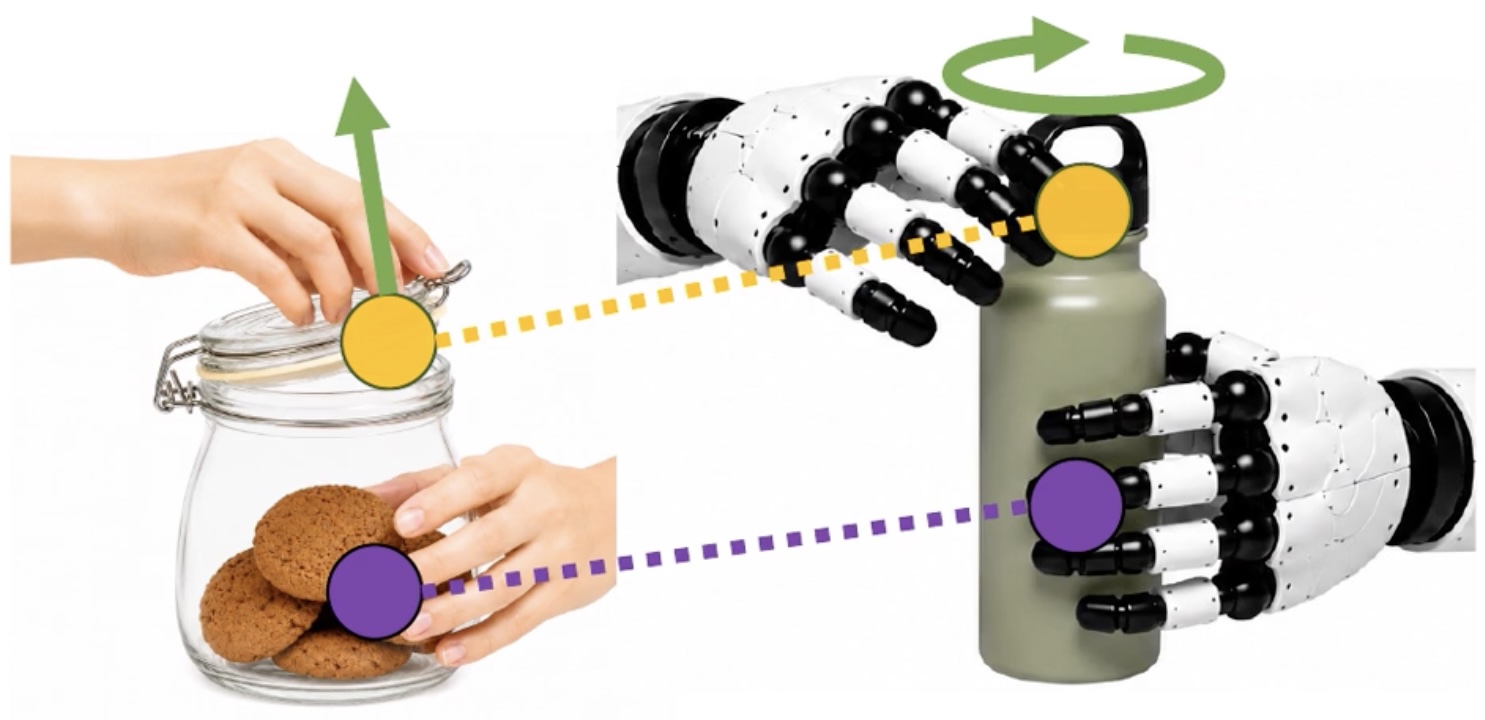 | Bi-Adapt: Few-shot Bimanual Adaptaion for Novel Categories of 3D Objects via Semantic CorrespondenceJinxian Zhou*, Ruihai Wu*, Yiwei Liu, Yiwen Hou, Xunzhe Zhou, Checheng Yu, Licheng Zhong, Lin ShaoInternational Conference on Robotics & Automation (ICRA), 2026, Best Paper Finalist Project Page / arXiv / Code Bi-Adapt is a diffusion-based framework for efficient and generalizable bimanual manipulation across novel object categories and complex tasks. |
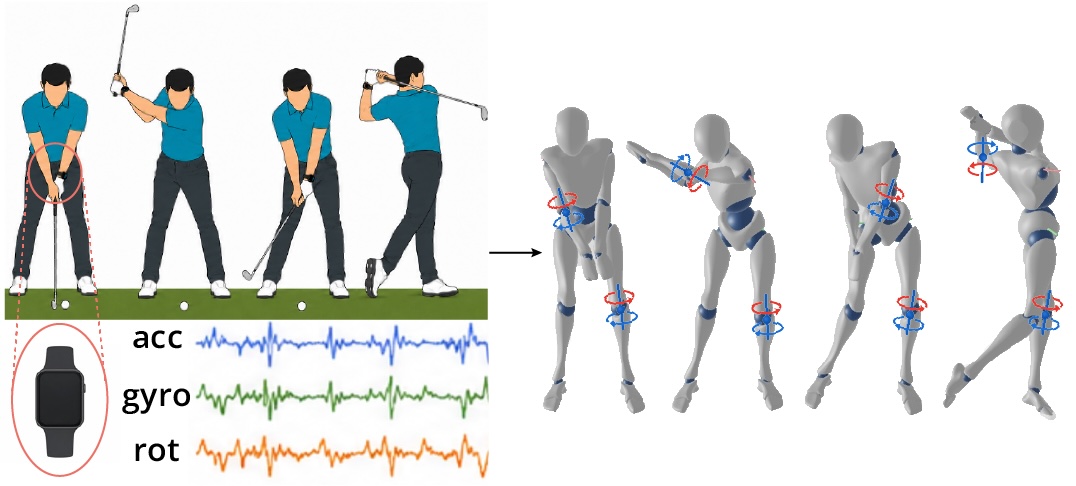 | Full-Body Golf Swing Kinematic Reconstruction From a Smartwatch IMUYuanshuo Tan, Kezhe Zhu, Xiujie Sun, Chunping Liang, Shuoyang Zhu, Chenquan Xu, Licheng Zhong, Huiming Pan, Yinri Jin, Chang Liu, Bo Xiao, Shenglong Le, Bryndan W. Lindsey, Peter B ShullarXiv preprint arXiv This work presents the first method for reconstructing full-body golf swing kinematics from a single wrist-worn IMU, enabling practical swing analysis during real-world play. |
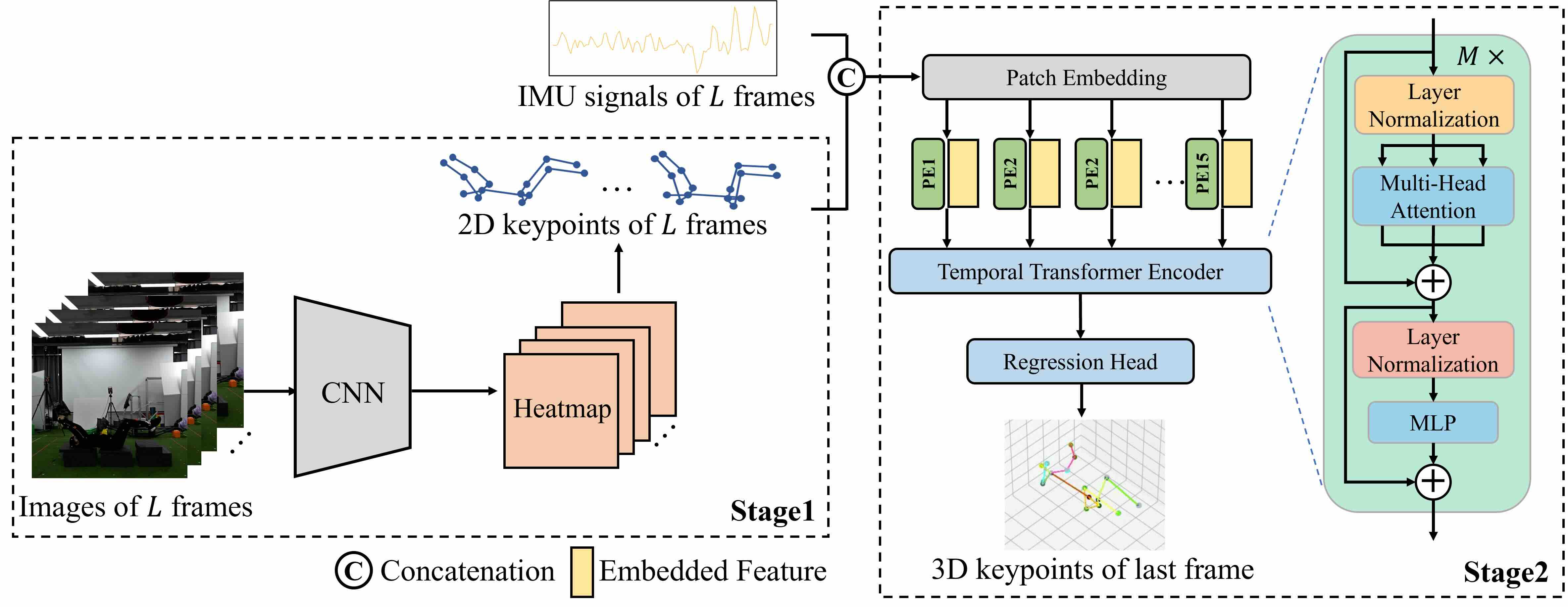 | Transformer-Based Full-Body Pose Estimation for Rehabilitation via RGB Camera and IMU FusionYuanshuo Tan, Xinyuan He, Guoxing Liu, Licheng Zhong, Huiming Pan, Kezhe Zhu, Peter B ShullInternational Conference on Body Sensor Networks (BSN), 2025, Oral Presentation Paper This work proposes a temporal transformer-based method that fuses images and IMU data to improve 3D human pose estimation for specialized rehabilitation exercises. |
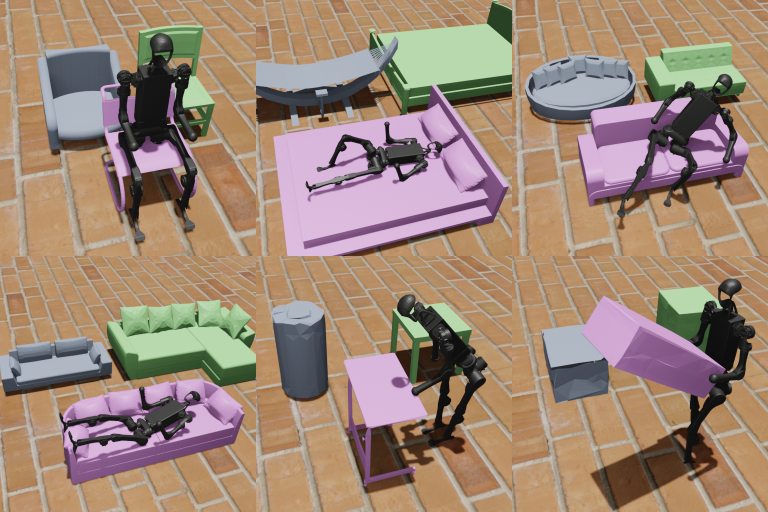 | Mimicking-Bench: A Benchmark for Generalizable Humanoid-Scene Interaction Learning via Human MimickingYun Liu*, Bowen Yang*, Licheng Zhong*, He Wang, Li YiCVPR Workshop on Humanoid Agents, 2025, Spotlight Project Page / arXiv A benchmark of Humanoid Scene Interaction. The first comprehensive benchmark for generalizable humanoid-scene interaction learning via human mimicking. Integrated a large-scale diverse human skill reference dataset with both synthetic and real-world human-scene interactions. Developed a general skill-learning paradigm and provide support for both pipeline-wise and modular evaluations. |
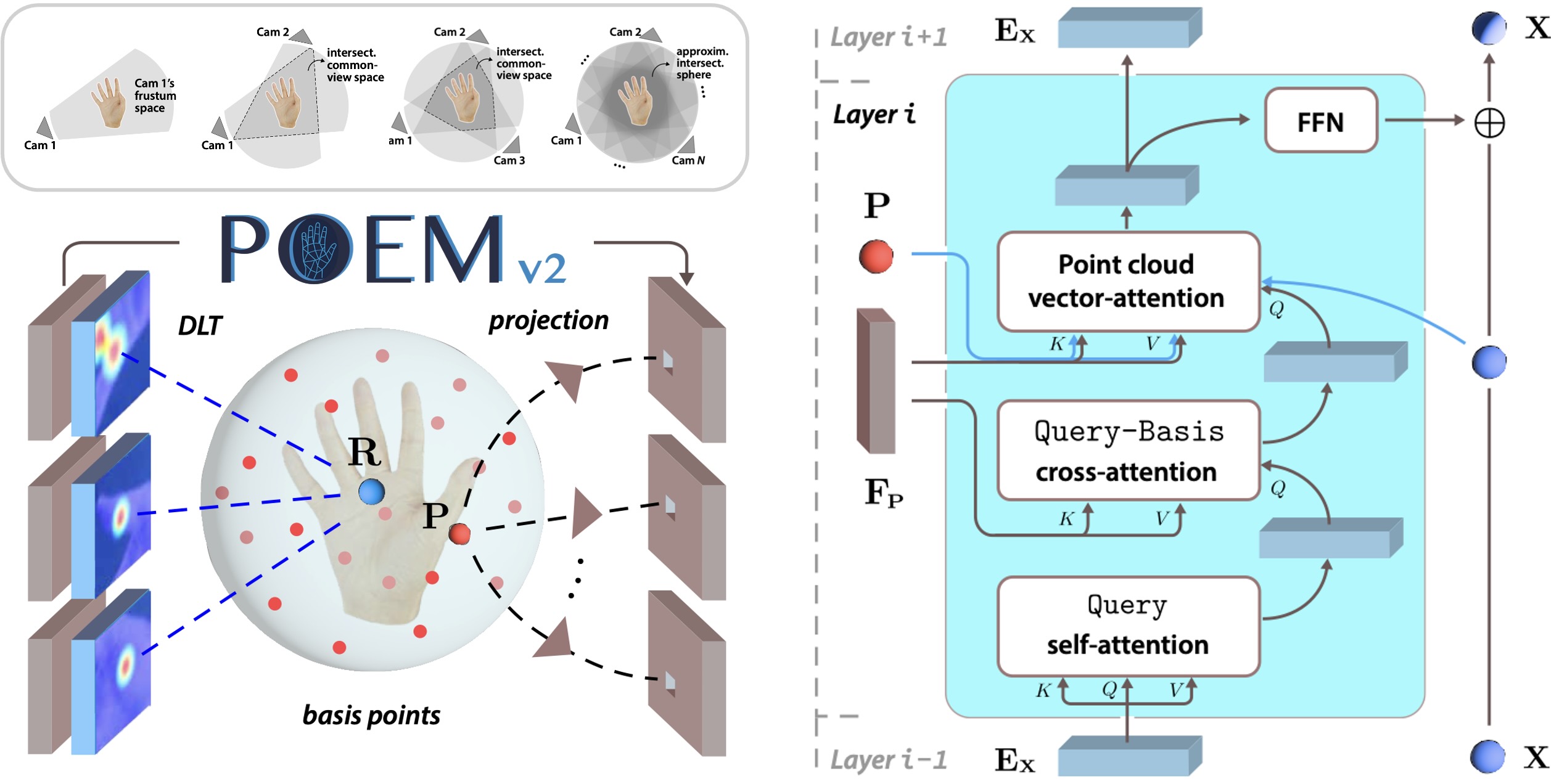 | Multi-view Hand Reconstruction with a Point-Embedded TransformerLixin Yang, Licheng Zhong, Pengxiang Zhu, Xinyu Zhan, Junxiao Kong, Jian Xu, Cewu LuTransactions on Pattern Analysis and Machine Intelligence (TPAMI), 2025 Paper / arXiv / Code  POEMv2 is a generalizable multi-view hand mesh reconstruction model which embeds a static basis point within the multi-view stereo space. |
Reconstruction and Simulation of Elastic Objects with Spring-Mass 3D GaussiansLicheng Zhong, Hong-Xing "Koven" Yu, Jiajun Wu, Yunzhu LiEuropean Conference on Computer Vision (ECCV), 2024 Project Page / Paper / arXiv / Data / Code  Spring-Gaus reconstructs the appearance, geometry, and physical dynamics properties of elastic objects from video observations. Spring-Gaus enables future prediction and simulation under different initial states and environmental parameters. |
Color-NeuS: Reconstructing Neural Implicit Surfaces with ColorLicheng Zhong*, Lixin Yang*, Kailin Li, Haoyu Zhen, Mei Han, Cewu LuInternational Conference on 3D Vision (3DV), 2024 Project Page / Paper / arXiv / Data / Code  Color-NeuS focuses on mesh reconstruction with color. We remove view-dependent color while using a relighting network to maintain volume rendering performance. Mesh is extracted from the SDF network, and vertex color is derived from the global color network. We conceived a in hand object scanning task and gathered several videos for it to evaluate Color-NeuS. |
CHORD: Category-level in-Hand Object Reconstruction via Shape DeformationKailin Li*, Lixin Yang*, Haoyu Zhen, Zenan Lin, Xinyu Zhan, Licheng Zhong, Jian Xu, Kejian Wu, Cewu LuInternational Conference on Computer Vision (ICCV), 2023 Project Page / Paper / arXiv / PyBlend  We proposed a new method CHORD which exploits the categorical shape prior for reconstructing the shape of intra-class objects. In addition, we constructed a new dataset, COMIC, of category-level hand-object interaction. COMIC encompasses a diverse collection of object instances, materials, hand interactions, and viewing directions, as illustrated. |
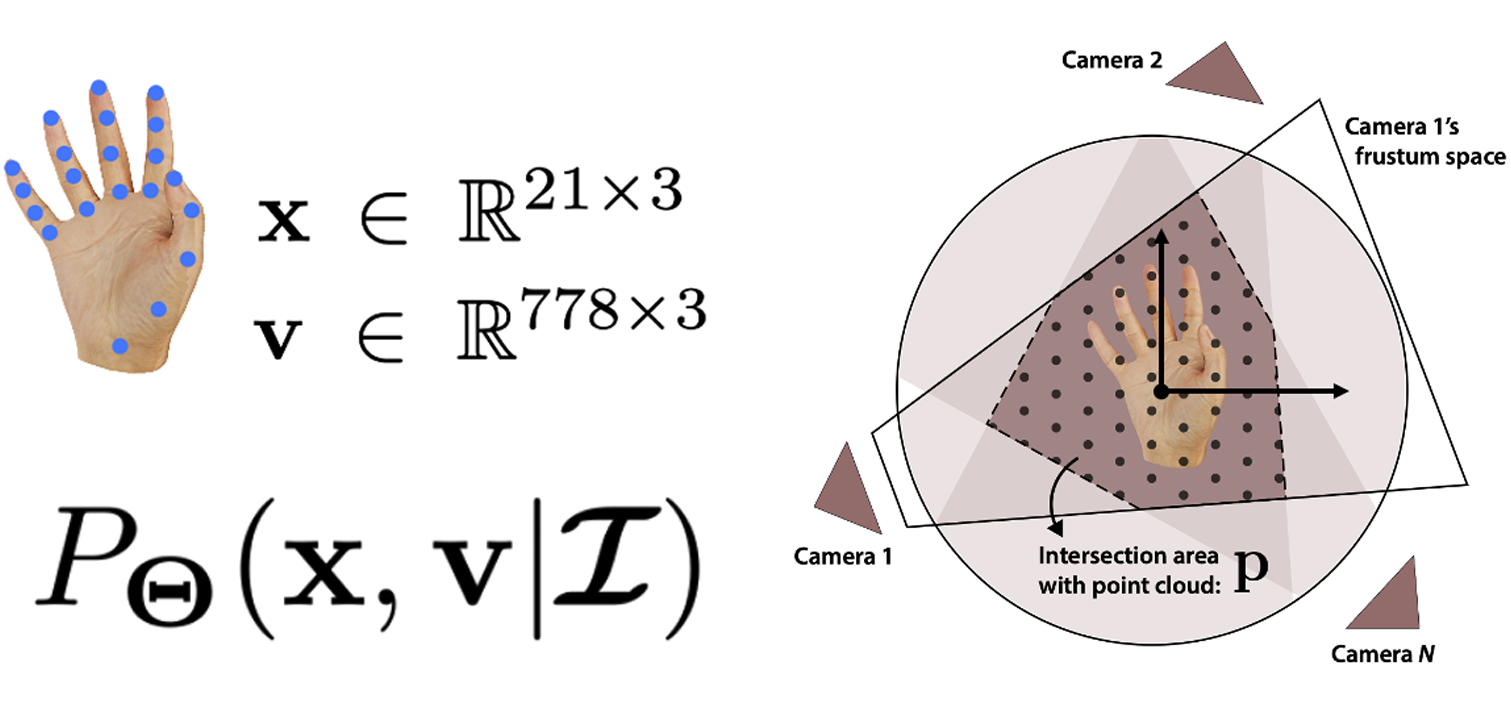 | POEM: Reconstructing Hand in a Point Embedded Multi-view StereoLixin Yang, Jian Xu, Licheng Zhong, Xinyu Zhan, Zhicheng Wang, Kejian Wu, Cewu LuComputer Vision and Pattern Recognition (CVPR), 2023 Paper / arXiv / Code  POEM (Point Embedded Multi-view) focuses on reconstructing an articulation body with "true scale" and "accurate pose" from a series of sparsely arranged camera views. In practice, we used the example of hand. POEM explores the power of points, using a cluster of (x, y, z) coordinates with natural positional encoding to find associations in multi-view stereo. |
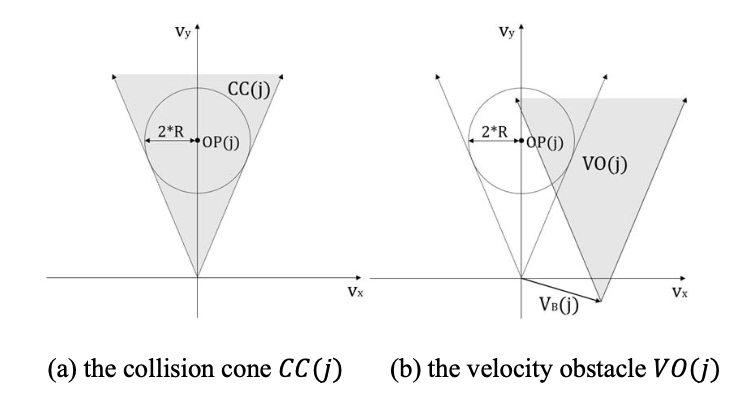 | Centralized and Decentralized Methods for Multi-robot Safe NavigationXinbei Wang*, Zexuan Yan*, Licheng Zhong*Machine Learning and Intelligent Systems Engineering (MLISE), 2022 Paper We simulated two centralized methods and two decentralized methods for multi-robot safe navigation in their respective environments. |